
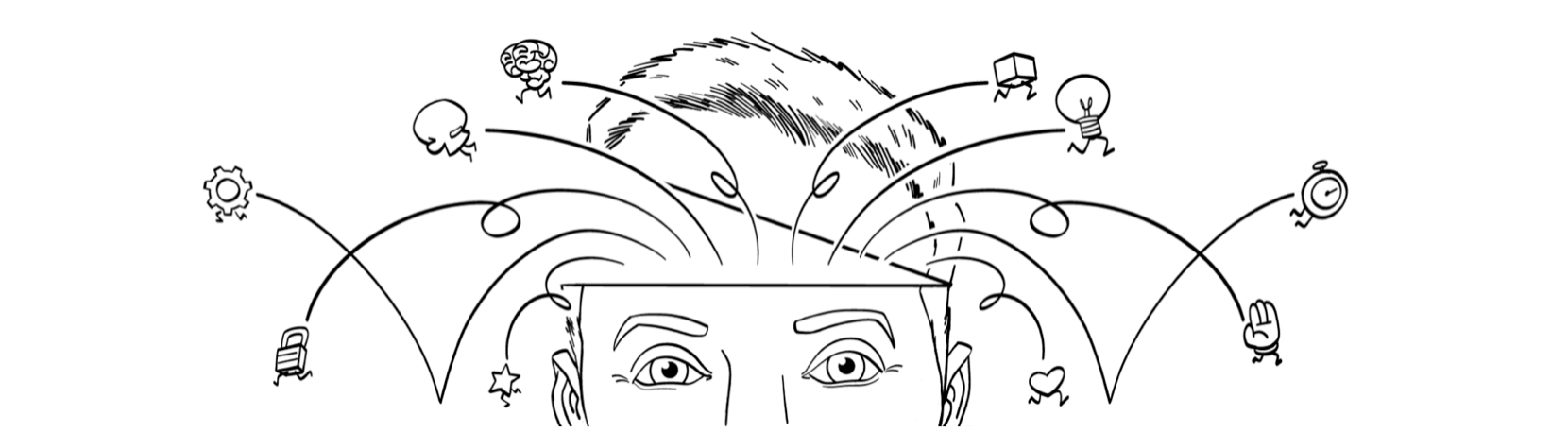
In this week's edition of Idea Surplus Disorder, you’ll learn how to ask your manager for what you really need—without making them guess.
We’ll explore why leadership can be both lonely and angry, what innovators should do once their bold ideas become obvious, and how to rebuild a culture that celebrates deviance instead of conformity.
Plus: prompts for getting weirder (and better) results from AI, a simple test of team confidence, and a lesson from the man who sold books by selling bookshelves.
And as always, you’ll find a mix of fun finds, practical insights, and thought-provoking quotes to help you lead, live, and think more intentionally.
I'm Matt Homann, and I'm glad you're here.
Ideas + Insights
Want something from your manager? Be explicit about what you need:
Your manager wants to know: “How can I help you? What do you need from me?” I’ve listened to direct reports speak for 10 minutes, and at the end, still didn’t know what they wanted me to do. This is a good format to kick off the conversation so your manager knows what you need:
“I’d like to give you an update about X, and the thing I need from you is Y, ideally by Z date.”
Basically, don’t make your manager think too hard just to approve your work.
When you share an appropriate amount of context up front, they’ll be able to approve and get off your critical path. Then you can continue doing great work that makes you and your manager proud.
Why does leadership get so lonely (and angry)?
Measuring overall life satisfaction, the data showed that people who were moving toward promotion were usually getting slightly happier in the five years before gaining a leadership position.
They became unhappier when the promotion occurred, however, and their satisfaction didn’t recover to the pre-promotion level until two years into the new job. Only after that did their happiness resume a gradual upward trend.
A more striking effect occurred with anger, which significantly increased after promotion and did not fully abate for another five years.
As research has shown, the anger of leaders may be associated with problems such as anxiety among subordinates and the perception of petty tyranny. Anger decimates the desire of others to follow.
Want to sell books? Focus on the bookshelves:
Back in the 1930s, the so-called Father of Spin, Edward Bernays, Sigmund Freud's nephew and a marketing genius, had a brilliant idea. He was doing work for a publishing consortium when the stock market crashed to keep the people buying books – he focused on the shelves. Where there are bookshelves, he is quoted as saying, there will be books.
Bernays got boldface names to install bookshelves in their homes. House and Garden magazines began to feature homes with built in bookshelves as signifiers of class. And voila! The manipulative marketer gave rise to the personal bookshelf. As a mark of education, taste and cultural cachet for the masses.
The Decline of Deviance:
Whenever you notice some trend in society, especially a gloomy one, you should ask yourself: “Did previous generations complain about the exact same things?” If the answer is yes, you might have discovered an aspect of human psychology, rather than an aspect of human culture.
This is, I think, how we end up in our very normie world. You start out following the rules, then you never stop, then you forget that it’s possible to break the rules in the first place. Most rule-breaking is bad, but some of it is necessary. We seem to have lost both kinds at the same time.
For the first time in history, weirdness is a choice. And it’s a hard one, because we have more to lose than ever. If we want a more interesting future, if we want art that excites us and science that enlightens us, then we’ll have to tolerate a few illegal holes in the basement, and somebody will have to be brave enough to climb down into them.
To get better AI results, prompt weirder:
- Channel historical problem-solvers. How might figures who made their mark on the past manage my little strategic query.
- Example: If Maya Angelou were mediating this team conflict, what questions would she ask that no one else is considering?
- Insist on strange cross-pollination. Require the borrowing of concepts, frameworks, or terminology from vastly different domains.
- Example: “Analyze my [business / creative project] through the lens of marine biology. What patterns or ecosystem principles could apply here?”
- Apply disaster movie logic. Push an AI assistant to consider a workplace problem with the urgency of a crisis scenario to explore unconventional ways to quickly address a slow-moving issue.
- Example: “This team project has 48 hours before catastrophic failure. What unconventional resources could we deploy? What rules would we break to succeed?’
- Embrace absurd analogies. Challenge the AI to reply in terms that may seem silly at first, but may yield unexpected clarity.
- Example: “To help me simplify the most confusing aspect of my presentation, explain my fundraising strategy [X] as if it were a board game instruction manual.”
Innovators, don't fight your own success:
Here is what success looks like: your crazy ideas become obvious to others, and no longer the wild, brave, brilliant insight. Eventually, if you do your job right, everyone will come around to your view, or adopt your new hard-won methods, and the common narrative will neglect all the travails you had along the way.
It can be shocking to suddenly not be the trailblazer, once everyone else catches up. It’s a recipe for misery, if that makes you upset or if you see others jumping on the bandwagon as them “stealing it”. You need to come to grips with the fact that the new idea that only you saw, will eventually be “obvious” if you succeed.
When you're hiring, are you this confident in your team?
One good test is when you’re recruiting a new person, you should be able to say to them, “Walk into that room where the rest of the team is sitting. Take anyone you want—pick them at random—pull them aside for 30 minutes, and interview them. And if you aren’t impressed by them, don’t join.”
And if you're nervous about it ...
When you do that test, you will instinctively flinch at the idea of them interviewing randomly a certain person that’s kind of in the back of your mind. That’s the person you need to let go. Because that’s the person keeping you from having this high-functioning team that all wants to impress each other. That’s the bar you have to keep, especially for all the people you’re going to directly manage—the first 20, the first 30, the first 40, the first 10—whatever that number is.
Need to learn something new? This tutorial on how to use Google's NotebookLM is a great primer for how to learn hard things.
Here's a simple travel packing idea from Nomadico:
If you’re going to get rid of something in your closet, like a pair of shoes, a shirt, or pants, then wear the item(s) on your next flight or pack them. Then ditch them after you’ve worn them a few times in the destination, lightening your load for the remainder or the return. (Or making space for new purchases.) Donate if the item is still nice, otherwise trash it abroad like you would have done at home anyway.
Fun Finds
- You are insignificant. And that's a good thing.
- Why do so many book covers look the same?
- Made Up Machines
- Take longer walks.
- Red String Mystery-Solving Boards
- One longer walk is better than several shorter ones.
- In defense of picky eating.
Words of Wisdom
I avoid looking forward or backward, and try to keep looking upward. – Charlotte Bronte
Evolution is like a brilliant uneducated craftsman: what it lacks in intellect it makes up for in experience. – Rory Sutherland
The people who have the hardest time are the people who are fighting the future. – John Mayer
The counterfeit innovator is wildly self-confident. The real one is scared to death. – Steven Pressfield
Statistically speaking, a normal person is physically unhealthy, emotionally anxious and depressed, socially lonely, and financially in debt. So f*ck being normal. – Mark Manson
Reality is that which, when you stop believing in it, doesn't go away. — Philip K. Dick
Inspiration is a guest that does not willingly visit the lazy. – Tchaikovsky
Results tend to accumulate to the person who enjoys the lifestyle that precedes the result. – James Clear
When we are crushed like grapes, we cannot think of the wine we will become. — Henri J. M. Nouwen
Up Next From Filament
Every month, Filament delivers an incredible mix of free programming and professional development. You can find links to sign up for all of our upcoming events, including PlayDays, Wavelength, NSFW, and SuperCollider here.